Wednesday, July 31, 2013

Sitting On The Dock Of The Bay - Smitty's Clam Bar, Somers Point, NJ


A ten-minute drive from the tourist traps along the Jersey shore boardwalks, Somers Point, a sleepy and oft-overlooked marina village on the bay, is home to one of the greatest seafood dives on the East Coast - Smitty’s Clam Bar. While it might seem obvious that you can get great seafood near the coast, palatable dining on the Jersey shore is surprisingly hard to come by. Restaurants seem to come and go with each summer season, aside from a few classics that withstand the yearly ebb and flow of visitors. Throughout most of my childhood, my family spent many steamy summer nights at Smitty’s, filling up on fresh fish and fried clams on our way from Atlantic City to ride the rides at Wonderland Pier in Ocean City.


Smitty’s is universally beloved by a loyal following of diners. Come Memorial Day, chowderheads line up snarling to fight for first-come bar seating or brave the hour-long wait for a table inside, pacifying their children with cartons of french fries. The food is just that good. Arriving just before Memorial Day, we luckily missed the sideshow.

We each ordered a cup of the red clam chowder, served spilling over the side with a packet of saltines. The tomato stock is rich, and well-seasoned, thick with potatoes, carrots and giant, meaty pieces of clam. For addicts, Smitty’s sells quarts of the stuff that you can take home, freeze, and eat in the dead of winter when you’re aching for summer.

The tuna.
The fish is gratuitously sauced in simple elements like garlic, lemon, and olive oil. It’s broiled in a ceramic dish which gives the fish the ultimate balance of a crispy exterior and delicate inside. We picked the mako shark and the tuna, both sizzling in a soy, ginger, and wasabi blend. It’s a powerful feeling to consume something with the capability of eating you. The food is not about revisionism, it’s about freshness and flavor, the way great seafood should be.
The mako shark.
The elderly couple that sat down next to us were clearly regulars, greeted with everything short of a kiss from the entire staff. Their adorable waitress knew their order by heart, including the gentleman’s birch beer. It’s Cheers in real life, for the Jersey shore set.

The place is not by any means fancy, with plastic chairs, specials scribbled on a white board, and their menus designed in crayon by the youngest patrons. But sitting dockside, twenty feet from where your dinner was plucked, makes for one of the most authentic dining experiences on Earth.

Monday, July 29, 2013

God Save The Village Green - New Castle, DE


I hope our friend Caitlin – an alum of the University of Delaware – is not too righteously offended by this, but neither of us had lofty hopes for the state of Delaware. We went into it knowing three things about it:

1.)   It was the first colony to become a state.
2.)   It is very tiny.
3.)   Joe Biden is from there.

The only big thing about Delaware known in most of popular culture is this scene from Wayne’s World:


Somebody tell their board of tourism this, but our moderately low expectations were exceeded ten times over. Aside from a quick jaunt through Wilmington, which was just another Mid-Atlantic shithole, we were delighted to find several towns that time forgot. The first we visited was New Castle, just six miles south of Wilmington. New Castle looks like it hasn’t changed since the late 18th Century, complete with an English-style village green. At the north end of the village green is an Episcopalian church from the 1700’s. In describing it to a friend, I said it was like the town is a giant Kinks song, a quaint village with a deep reverence toward its past.

One of the main drags in New Castle.
In the present day, cities have their own ethnic enclaves, where the spirit of “back home” manifests itself in the architecture, the signage, and the types of stores in the neighborhood. Currently, there are a large number of immigrants from Africa, South Asia, and South America coming into the United States, all of them bringing their cultural heritage and artifacts as the latest ingredients in our cultural stew. Before that, it was my great-grandfather coming by way of Sicily and Alexa’s great-grandparents coming from Warsaw, Poland. At the same time, there was a massive wave of Chinese immigrants. Before that, it was the Irish (including the ancestors of my maternal grandfather). In a weird way, New Castle is the British take on the ethnic neighborhood, like Wee Britain from Arrested Development, only real.

The Episcopalian church on the green.
There have been some criticisms about Williamsburg, Virginia, for replicating (rather than restoring) all of the old homes from colonial times; New Castle, by contrast, is the real deal. The gorgeous homes here have been treated with the utmost care, with friendly locals out tending to their gardens and saying hello to passersby. There were also more people on bicycles than there were automobiles. As a low-key and comparatively small town, it seems to attract dedicated followers rather than gaggles of waddling visor-wearers fresh off of a tour bus.


New Castle marked a great start for our trip through Delaware, which included stops in Dover (the only state capital that looks like a college campus), Rehoboth Beach (the only East Coast beach town we visited that had not been overtaken by neon-lit consumerism), and Lewes, which itself was another town that time forgot, albeit with a pronounced maritime flavor.

We also saw this.

Tuesday, July 16, 2013

What's New In Baltimore? - Baltimore, MD


Baltimore is a rough city to navigate, with its downtown overrun by impoverished and dangerous neighborhoods and drivers who possess about as much value for human life as a drone strike. It seems to be one of those cities where every few years someone starts a rumor that it’s on the rise and cool things are happening, but that generally just means they finally got a Crate & Barrel and there weren’t any homicides in the gentrified (read: white) neighborhoods.

We began the afternoon in what we now believe might be Baltimore’s only livable neighborhood, made popular by Baltimore’s flashiest son John Waters and his attraction to several of its book and record stores. Even the hip area seemed to attract a strange crowd of derelict meth-heads, the types one would be inclined to see manning the water-gun game at the county fair, instead roaming the streets in the middle of the day. The neighborhood, while an oasis, was still nothing out of the ordinary. An overpriced vintage shop here, a record store there, a tattoo parlor around the corner, and plenty of yoga studios.


When we attempted to visit Billie Holiday’s former residence, we were averted after realizing it was now a housing project in a neighborhood where we didn’t even feel safe inside our car. From the street, there was no indication that the building was of any historical or cultural significance - no sign, no plaque - so we just kept driving.

We paid our respects to Edgar Allan Poe, whose grave still garners flowers and love notes 164 years after his death. Buried just inside the entrance to the cemetery, next to his bride Virginia Clemm, what was once a quiet graveyard is now surrounded by the stench of diesel exhaust, the wailing of sirens at the nearby medical center, and all sunlight blocked by the towering office buildings. It seems something of a dishonor for the American master of horror, suspense, and all things gothic, but at the time of his death, the church was the centerpiece of the city, which itself was built around it. We circled through the surrounding graves, some dating back to the early 1700s, worn and weathered from the years. The cemetery ended up being our small moment of calm that day, edging out the noise of downtown, interrupted only when we spotted a bum napping on top of a headstone and decided it was time to leave.


We followed signs for Poe’s Baltimore home only to discover that the building is now surrounded by housing projects and across the street from a vacant lot, the kind of place to dump off a body...or at least a duffel bag of spare parts. We chalked it up to another instance of incredibly poor city planning, but it still left us feeling like The Wire might actually be a more accurate representation of this sad city than any local government official would like to admit. Baltimore’s piss-poor job preserving and marketing what could be an immense source of tourism makes one wonder if the people running the city even care about drawing visitors, a nearly insane notion after visiting places like New Orleans and Williamsburg that thrive on it. The home of America’s first truly great writer, whose works defined an entire genre of literature, is smack in the center of the kind of neighborhood one can hear described in a Bobby Womack song.

Poe's Baltimore home.
Across the street from Poe's Baltimore home.
The Inner Harbor, Baltimore’s most well-known tourist destination, seemed more like a giant waterfront mall than something actually worthy of an entire afternoon. It is something we are noticing with an increased frequency that exists in cities such as this, where the token “place to go” is little more than a glorified shopping mall, the place where you can buy some artifact proving that yes, indeed, you did go to Baltimore and spent too much money on a stupid little lime green shirt illustrating that fact. We opted to avoid the hordes of Vacation Families™ and shot down to Annapolis to stuff our faces with crab, which seemed like a much better way to spend the evening.

Maybe everyone just has a different idea of what vacation is than we do. This is starting to become a problem.

Tuesday, July 2, 2013

American Royalty: Solomon's Castle, Ona, FL


For the average Florida tourist, the only castle on the peninsula belongs to Cinderella. Roughly a hundred miles from the calculated splendor of Disney World, off unpaved country roads, past a group of vultures snacking on a deer carcass, where cell reception goes black, is another palace, made entirely from repurposed junk.

To twist the old adage, one man’s trash is definitely still another man’s treasure - bringing us to Solomon’s Castle, one of the places that helped inspire the American Weirdness project back in the autumn of 2012.

Howard Solomon is the king of this castle, though he opts for a skipper’s hat rather than a crown. He moved to the central Florida property in 1972, having bought it on the cheap. With the first late-summer rains, Solomon realized he had scored a massive deal on acres of mosquito-infested swampland. He began construction on his regal residence that year, transforming the waterlogged acres into a recycled wonderland. It withstood hurricanes Charley, Jeanne, and Frances, which all tore through Ona, ripping out groves of old oak trees but leaving the castle unharmed. Now in his late 70’s, Solomon presides over a massive kingdom, one both unique and ever-expanding.

The castle features over 90 hand-made, stained-glass windows, depicting images of nursery rhymes, zodiac symbols, and the planets. The exterior panels are made of a holographic metal that changes colors in the sunlight. A black and white knight stand watch at either side of the entrance - Knight and Day.


While serving as a residence for Solomon and his wife, the castle is also a museum of his artwork, crafted entirely from found objects. He has used oil drums, beer cans, and failed appliances, even re-appropriating the cylinder of a Volkswagen Beetle into one of his sculptures. He made a menagerie of animals out of coat hangers, weighing nearly 50 pounds, and has crafted over 300 cars out of beer cans, the only project he says he doesn’t remember making. It took him over a year to gather the parts to create a steam engine that runs on a working Hoover vacuum motor. He made a carousel from old record players, complete with singing figurines in the style of “It’s a Small World After All.”


Our tour guide, a Vietnam War veteran, blessed with the quick rap of a vaudeville performer, took every opportunity to crack jokes about the sculptures and their pun-filled monikers. He stopped beside a six-foot-long metal Lion named Lionel, quipping “Lionel has two glass eyes and two steal balls.” The “Lorena Bobbitt” shotgun has a knife attached, to keep fidelity in check, and the “Mother-in-Law” clock, which runs backwards with the three on the left and the nine on the right.


Between 1990 and 1994, Solomon built the Boat in the Moat, called the Santa Maria, a restaurant run by Princess Solomon and her husband that serves country-style lunch fare. Two years ago, Solomon created the Alashmo, his version of the Alamo, right next door to his daughters home, which he also built himself, a deep brown stucco structure called The Chocolate House.

Remember the Alashmo. 
Lunch like a pirate.
King Solomon is never far from his castle, greeting visitors with a lissome grin and taking their tickets. It took a few minutes for us to even realize that he was the Solomon of Solomon’s Castle, taking a Saturday off from his workshop on the premises to man the register.

Solomon’s Castle is one of the most interesting pieces of living art in the cultural wasteland of Florida, made by a true, original Dadaist. If you’re not in love with paying $100 for the screaming, vomiting experience of Disney World to stand inside a castle, drive the 90 minutes to Ona to visit one created by a real artist for a mere $10.

Despite his age, Solomon assured that he plans to keep expanding and creating so long as he’s able.

“Some day,” he said. “The castle will be my kids problem.”

Thursday, June 20, 2013

Art is Hard: The Salvador Dali Museum, St. Petersburg, FL


The Dali Museum, a grandiose hull of glass nodules and steel adjacent to a marina in St. Petersburg Florida. Only a few years old, the powers found it necessary to destroy the former Dali Museum in order to erect a new one, not for efficacy reasons but for aesthetics alone. Our friend Danielle with whom we were staying told us this trend is increasing along the waterfront to the point where locals have begun protesting the destruction and recreation of a shoreline site called The Pier, simply because some find it outdated, at the behest of taxpayer dollars and the possible malnourishment of the pelican population. Why fix what isn’t broken? Because we can afford it, goddamn it!

In the lobby of the museum sits a remake of Dali’s Rainy Taxi, which by the insertion of a dollar bill into a slot causes simulated rainwater to pour through the interior of the automobile, soaking both the molding mannequin in the backseat and the shark-headed chauffeur. The original exhibition included chicory plants and live snails which crawled across the plastic woman. Its pay-per-play remake did not.

Snails not included.
As a tribute to the artist who was quoted once admitting a love for everything gilded and excessive, the institution exists solely to serve to the upwardly mobile their monthly helping of culture, celebrating the depraved opulence of the allotted few and not the collection of one of the greatest creative minds of the 20th century. It is, as with the yacht club or the golf club, a place to be seen and to socialize, a spot to nibble on cheese plates and sip $7 glasses of low-rung wine at the commissary and not to engage in a sensory experience with the present art. They are shopping, plugged in to their headsets, their faces saying “This one would look lovely in the pool house. Do you think they take checks?”

The appeal exists because Dali’s work is different enough to earn culture points but not outwardly shocking enough to spark real, introspective thought among these people, fighting their twanging discomfort in front of a wall-length portrait mocking the crucifixion of Christ or a topless portrait of his wife and muse Gala at the kitchen table. Anything more intense and they would barf into their Hermes handbags.

Their mentality is disturbingly appropriate as the collection itself began as one of the largest, private collections of the artists’ work in the United States, owned by a big-money couple from St. Petersburg who began collecting in 1943. The now amassed 1,500 works consist of still lifes of fruit bowls and landscapes of the artists’ hometown from his early art school days and the extravagant, absurd masterpieces he labored over in the final years of his life.

The art is exquisite and it is striking to see his works in person, many of them taking on varying shapes and meanings when viewed from different distances and angles. The motifs running throughout - the silhouette of the Venus de Milo, Gala,  melting clocks and globes - are traceable when viewed as a massive, live portfolio, witnessing his transition from student to artist, discovering his sense of Surrealism around the time he met idol Pablo Picasso.

Migrating through the mingling browsers - if you have the stomach for snobbery - there’s something hysterical about people fantasizing about art they’ll never own or even really understand. They’re more interested in what’s in the gift shop and who’s at the snack bar, anyway. We cannot help but wonder what Dali would have thought of such a clash - the very people he sought to satirize and shake out of complacency, quietly gazing at his works as though they were at the Sistine Chapel. Would he love it? Would he hate it? The answer is not one or the other, nor does it lie somewhere in between. It is in fact a trick question: he would probably pull the fire alarm and wait outside to spray patrons with a hose.

Tuesday, June 11, 2013

I Love The Dead: The New Orleans Historic Voodoo Museum


I might as well come out and say it, as if we didn’t make it obvious enough to anyone and everyone we have talked to since our jaunt through the South, but Alexa and I both loved New Orleans. LOVED it. One of the things we admired the most about it was the amount of acceptance and assimilation that has taken place there. It still has its problems, and we saw a few sketchy characters – like the kid rolling a blunt in Armstrong Park who also huffed some blow off of the back of his hand, or the man with the bloodied face filling out a police report on the “other” side of Elysian Fields – but ultimately, it is one of the most welcoming places in the world.

What makes it so welcoming? It is just as easy to point to the colorful buildings – the marriage of diverse architectural styles and shockingly bright colors make New Orleans a psychedelic experience* – as it is to the broad culinary palate that existed in NOLA (word for the wise: no one down there calls it the Big Easy. Nobody.) long before the foodie explosion of the early Aughts. Let’s not forget the ever-present sounds of music, usually performed live on a street-corner, that also pulls you in. What I think makes New Orleans so enticing is not the architecture, the food, or the music – although those are all added values.

It’s the people.

As a town driven in no small part by year-round tourism, its biggest draw is no doubt the party atmosphere. Second only to Vegas, NOLA serves as a venue for typically demure businessmen attending a sales convention, virginal bachelorettes, and good timer frat boys to get completely and utterly shit-faced. We are talking just totally ruined, as in puking into the nearest catch basin at four in the afternoon, after debasing and embarrassing themselves along every inch of their downward spiral to this point.

This is where the locals come in.

Conscious as to why so many people flock to New Orleans – and after all, where else can you publicly double-fist tumblers filled with daiquiris? – the locals are understandably wary of out-of-towners. Some, as we witnessed, are downright mean to the stumbling drunks on Bourbon Street, and to our delight, especially since New York City’s tourism industry is regarded as a sacred institution. For the out-of-towner seeking more than the gratification of their id, expect – after some initial curtness – to meet the nicest people in the world.

Such was our experience with John T., the resident psychic and clerk at the New Orleans Voodoo Museum. Sitting behind the counter in a cloud of incense smoke and with the piercing eyes of a mystic, John presented an intimidating presence. With its location in the heart of the French Quarter, on Dumaine Street between Bourbon and Royal, John no doubt sees his share of tourists who treat the Voodoo Museum (or at least its front room, since there is no admission fee for that) as though they were on safari. When we came in and asked questions about the cost of tickets, the test began.

“Tell me,” he asked, in a Southern accent that was both charming and slightly discomforting, “what are your signs?”

“Capricorn and Cancer.”

John’s eyes widened.

“Capricorn and Cancer?” He sat back and folded his arms, shaking his head slightly. “Oh, that is a match made in Hell.”**

He went on to ask us about our interest in Voodoo, picking our brains to make sure we weren’t just there to treat something he takes so seriously like a joke. I told him we were interested in studying religions and belief systems, and that we were particularly fond of rituals, images, and objects held sacred by them. With a glint in his eye that was somewhere between an avuncular twinkle and a spark of Hellfire, he told us that what the museum featured was good and well, but that what he had in his third-floor apartment upstairs was something different altogether.

Raising his eye-spark with one of my own and a half-smirk, I asked what we would find upstairs?

“Oh, I have things up there that would send you running into the street.” He returned the smile, no longer trying to scare us but instead playfully teasing. “You wouldn’t last five minutes!”

With that, we passed the test. It is only left for us to speculate how other people would carry on during this psychic game of poker, but I would imagine the visitors being much more stand-offish. John smiled and told us about the museum: it was founded in 1972, that he himself is the resident psychic as well as a practitioner. He also added a fair warning for us before we entered the museum.

“Anything you see involving body parts or animals is not there for the fear factor. It is there because these are things used in Voodoo ceremonies and rituals. They are used because Voodoo believes God is present in all living things.”

And it is on that note that we present our own photos of the Voodoo Museum:

Baron Samedi, left, and the Rougarou, a Cajun variant of the werewolf, on the right.
The New Orleans Rougaroux has a much better ring to it than the Pelicans, don't you think?
It would certainly make for more interesting merchandise.

Voodoo has its origins in the folk religions of West Africa.
Historically, to allow Voodoo practitioners to hide in plain sight, Catholic saints were used in place of Voodoo spirits.
There is a unique reverence for the dead based more in celebration and ancestor worship, rather than fear.
Part of a display case depicting Voodoo symbols (the rainbow snake on the back tapestry represents God) and offerings.
Voodoo offerings made in Saint Louis Cemetery No. 1.
Different offerings mean different things: makeup signifies romance, jewelry signifies the desire to seduce, lottery tickets signify wealth and prosperity.
After the museum, we had a nice conversation with John, during which a group of tourists came in, doing exactly what we thought they would do: they took pictures, asked how much the museum cost, lied that they “might be back,” and then promptly left. There is a lot more for us to share: our conversation with John, where he told us just what he had upstairs, the walking tour itself (led by Jerry Gandolfo, historian and brother of the Voodoo Museum’s founder), and an encounter with a Voodoo priestess in her temple (where she quoted Bobby “Blue” Bland and told me I was a seeker with an old soul – so yes, we got along swimmingly), but you’ll have to wait for the book for all of that.

* It is worth noting that neither of us have been to San Francisco – but we’ll get there.

** We look forward to one day telling our kids about the best compliment we ever received, and it will be the time a psychic in New Orleans said we were "a match made in Hell." (It sure beats the time a drunk in the East Village asked me if Alexa was my sister.)

Thursday, June 6, 2013

Trompe le Monde: Two New Orleans Icons: Napoleon House & Café du Monde

In keeping with the sometimes-we-do, sometimes-we-don’t tradition of dedicating a post to somebody, I would like to dedicate this entry to my dad, Eric DiBlasi Sr., with whom I first explored New Orleans in 2009.

This marked Alexa’s first time to New Orleans and my second, which allowed me to both revisit many of the same restaurants, shops, and other sites of interest from my first visit, while also doubling as a guide through my favorite place in the world. The afternoon we arrived, we dropped our bags off at the hotel and drove into New Orleans proper. I took us right to Napoleon House, at the gorgeous intersection of St. Charles and Chartres Streets, and one of many places where my father and I ate during my first trip to New Orleans four years earlier.

Napoleon House is a building with history literally etched into its walls, with the bricks visible beneath the cracked plaster. For a town that is already distinctly different from the rest of the United States (Voodoo historian Jerry Gandolfo called it “the north coast of the Caribbean,”) walking into Napoleon House is like stepping into a European bistro, albeit with a tropical climate.
Both times I ate there, I kept it simple and classic: red beans, rice, and sausage. No frills, no bullshit, nothing fancy. A staple of New Orleans cuisine, it is the perfect blend of flavors and textures. Words are barely enough to describe it. When done right, red beans and rice is a food experience that borders on the divine.
On my recommendation, Alexa ordered the muffuletta sandwich. An often-overlooked fact about New Orleans is that it boasts the largest Italian-American population in the United States. The muffuletta is an invention of Sicilian immigrants, featuring layers of meat (mortadella, salami, and ham) and cheese (provolone and mozzarella) on muffuletta bread, topped with a slightly spicy olive tapenade. The bread is somewhat like focaccia, thin and soft, and topped with sesame seeds. To soften the cheese – and also to make it into a melty bite of Heaven – the sandwich is usually served warm. Most restaurants will offer the sandwich in quarter, half, and full-sized portions. Measuring ten inches across, the full-sized portion is a lot of sandwich.

If the food is among the best things I ever ate (apologies to Alton Brown), then the atmosphere is even better. Featuring both indoor and outdoor seating, it is an ideal spot to enjoy a good meal, coffee and dessert, or to just sit back with a local favorite (Pimm’s Royal is highly recommended) and people-watch while listening to the classical music played over the house speakers.

We didn’t order it this time around, but when I visited New Orleans with my dad, I enjoyed the cassata (spumoni ice cream served with jelly and cake – a true delicacy) while my old man indulged in one of his favorite things on the planet, after Syd Barrett-era Pink Floyd, 1950’s sci-fi B-movies, and his Fender Mustang: the cannoli. Regardless of what you do there, no trip to New Orleans is complete without stopping by Napoleon House and just soaking in the atmosphere – but be sure to order something among all the soaking.
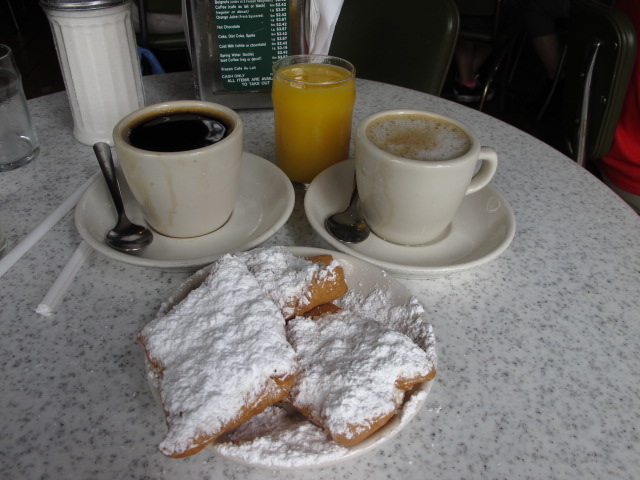
Just a short walk away from the Napoleon House is Café du Monde, one of the better known dining spots in the French Quarter, famous for their beignets and traditional New Orleans style coffee. The beignets, deep fried pastry fritters topped with powdered sugar, arrive steaming hot to the table under a large green and white striped canopy in pure French flair. The café au lait is another local must. The coffee beans are roasted with chicory, giving a peppery flair to your morning coffee. While Café du Monde is one of the more touristy spots, it is worth the visit. The beignets and café au lait make the perfect mid-afternoon snack or ending to a day in one of America's coolest cities.

Wednesday, May 29, 2013

Heart and Soul: Two Sisters, New Orleans, LA


In our travels, we have employed two methods of exploration: our own system of trial and error, and the recommendations of trustworthy locals. In Baton Rouge, we asked three security guards at the Louisiana State History Museum where to track down some good Southern cooking.

“What are you doing here?” they laughed. “You have to go to New Orleans!”

New Orleans was indeed our next stop, so we jotted down their suggestions, including a soul food restaurant called Two Sisters. On a dreary afternoon in New Orleans, we sought the gastronomic comfort of the Two Sisters. The restaurant, squeezed in the middle of a residential neighborhood near the Tulane campus, is inside a building that appears more suited to house a family than a family business. It is not until you step inside and taste their food that you realize the home-spun charm is the wonder of the Two Sisters - it is less like a restaurant and seems more like a kitchen table. 

The menu includes soul food favorites like catfish, fried chicken, and ham hocks and even items that might seem off-putting to the average diner like pig knuckles, chitlins (listed on the menu as “chitterlings”) and turkey necks. We ordered the oxtail and the smothered chicken, recommendations per our waiter, who didn’t flinch when we asked what the absolute best thing on the menu was. Some restaurants - the TGI McFunster’s of the world, as Anthony Bourdain calls them - the server, when asked which entree is the best, will twirl her hair and say, “Well, I dunno, they’re all amazing!” Not here. When we asked, “Which is better, the smothered chicken or the fried chicken,” the waiter said, without even a blink, “Smothered.” So we ordered it.

Smothered chicken.
The chicken arrived steaming, melting off the bone, and swimming in homemade gravy. The meat is so perfect you can’t help but wonder how long it’s been cooking and what kind of sorcery was involved. The warm gravy, while copious, is mild enough to let the real flavor of the chicken reveal itself. The entree was served atop a giant portion of sticky rice, alongside gooey macaroni and cheese and butter beans. They also give you a brick of moist cornbread, in case you find yourself still hungry after the platter of food.

The oxtail, a traditionally Caribbean dish that has made its way into soul food kitchens, was criminally tender. Expect to get messy as you will want to clear every, tiny morsel of meat from the bone. The self-conscious need not dine here.

Oxtail dinner.
The sides are as impressive as the main dishes, a bragging right not afforded to every restaurant. Two Sisters is the kind of place to be adventurous, because everything is good, and what is dining if not an event to experience something out of the ordinary?

Two Sisters is busy and not for those demanding luxury or overattentive service. It is incredibly popular among the locals for both its incredible food, almost unholy portions, and low prices. If you’ve got the patience, and don’t mind not being your waiter’s center of attention, it is completely worth it.

Tuesday, May 28, 2013

O, Come, All Ye Faithful: Elvis Presley's Birthplace, Tupelo, MS

The Elvis Presley Museum (no photos allowed inside)
This article is dedicated to our good friend Harry Sewlall, one of the biggest Elvis fans in the world, and certainly one of the biggest Elvis fans in South Africa.

If there is a cultural religion unique to American history – a source of devotion, dedication, and discipleship that can almost entirely be traced to happenings on American soil – my vote would be for Rock and Roll. As a New Religious Movement of the 20th Century, Rock and Roll is a syncretic religion, with obvious influences from other belief systems (Blues, Folk, Country, and Gospel), but with its own set of leaders and prophets.

Before our journey to Tupelo – which in itself is a nice little town, one that with its three local universities would most likely have retained its hip vibe with or without the presence of Elvis – I was among the rock history purists who balked at the idea of this greasy-coiffed hillbilly being the inventor of rock and roll. But no more, for I have seen the light!

Before I really begin flogging this metaphor to death, (and with comparative religion being one of my pet interests, I know very well that I could,) I will quickly jump to my conclusion: Elvis, for a segment of the population, is revered as a Christ-figure in our cultural landscape. Some of the more dedicated make pilgrimages to his tomb at Graceland, to where he did most of his early preaching in Memphis at Sun Studios, and also to his boyhood home in Tupelo.
The Lyric Theatre, a former Vaudeville venue where Elvis performed on a return visit.
The Elvis Presley Birthplace and Museum is set on a gorgeous piece of land just off of the main drag, with several unique exhibits. The first is the actual home where Elvis was born and subsequently spent the first 13 years of his life. A two-room shotgun house, recreated with period furniture and with wallpaper that is consistent with a few photographs taken inside the house, Elvis came from startlingly humble beginnings.


Across the pavilion, which Elvis had commissioned to double as both a museum and a park, is the Pentecostal Church the Presley family attended in Elvis’ youth. The church originally sat about half a mile down the road from the site, but in 2008 the Museum gathered the funds to pluck the church out of the ground and haul it to their park. Inside the church is a unique video presentation, where three screens come down from the ceiling, projecting a surround audio-visual experience of a typical Pentecostal church service. When we were there, a busload of senior citizens were visiting as well, and their reaction to the experience was similar to the awe of a child seeing Disneyworld.


Inside the museum itself is a massive gift shop. It has a lot of the usual Elvis ephemera – cookbooks, lunchboxes, t-shirts – but it also features every single one of his movies, a large number of complete concert and performance anthology DVD’s, and nearly every album Elvis released during his lifetime – although that awful Having Fun With Elvis On Stage album, the one that features only Elvis’ onstage banter between songs still has yet to be digitized. (On the one hand, this is probably for the best, but then again, I do have a morbid curiosity about it – the album reached #130 in the rock charts in 1974, and perhaps more disturbingly, hit #9 in the country charts!) Beyond the gift shop is a theater that shows a dramatized account of Elvis’ time in Tupelo. Shot locally with amateur actors, the end result is professionally done and actually boasts some great performances.


The actual museum gallery is roughly the size of the gift shop, a bunch of glass cases containing many of the physical artifacts from Elvis’ youth. With the help and generosity of a childhood friend-turned-collector named Janelle McComb, the museum also features items from Graceland and even some gifts given to her by Elvis himself. When we got to the exhibit featuring Elvis’ gator-skin shoes, his fur coat, and the church-meets-crushed-velvet aesthetic of Graceland, I turned to Alexa and said, “He lived like someone who won the lottery!” With his roots in extreme poverty – his father even spent time in jail for check forgery, altering an amount paid to him in an effort to pay of his debts more quickly – Elvis is the rags to riches story. He may have lived extravagantly, but it seems less like, say, The Great Gatsby and more like the scene in The Jerk when Navin Johnson makes his fortune.

At the middle of the pavilion is a statue of 13-year-old Elvis, clutching a guitar and clad in overalls, with a circle of plaques and engravings that detail major life events during Elvis’ time in Tupelo. Furthering the religious connection is a chapel on the premises, another component of Elvis’ plan for the site. Although it was closed, it was a modern-looking chapel with gorgeous stained glass windows. There are also markers placed by two separate Mississippi institutions, one honoring the history of Country music, the other honoring the Blues.

This duality of Elvis’ musical influences, of both white and black musical traditions – made obvious by the film, the church experience, and the museum gallery – shows why he is so relevant to the history of Rock and Roll. It doesn’t matter that he never wrote a song, that he was not a virtuoso musician, or even that he was a good-looking fellow with shaky hips. One need look no further than his first single, released on Sun Records, “That’s All Right, Mama” backed with “Blue Moon Of Kentucky.” Elvis took Arthur “Big Boy” Crudup’s blues tune and injects it with some country swagger on the A-side, and on the flipside gave Bill Monroe’s mournful ballad a jumpy blues background. It is that marriage of two seemingly disparate musical styles that gave us Rock and Roll, bereft of racial politics and who-did-what-first-ism.

Although I may still balk at Rolling Stone’s rockist white-boy assertion that “That’s All Right, Mama” was the first Rock and Roll record – such a statement only serves to generate debate, prompting the public to buy their publication, or at least bring traffic to their website – but my position on the lad responsible for the record has definitely evolved for the best. 

Praise Elvis!